The Forgotten Perimeter: Why Your Parking Lot Is the Security Vulnerability Hiding in Plain Sight
The Security Conversation That Almost Never Happens
Ask most business owners where they feel most secure, and they will describe the inside of their building. Access control systems on the doors. Cameras in the hallways. A guard at the reception desk. The perimeter, in their minds, begins at the front entrance.
Ask them about the parking lot, and the conversation changes. A few lights. Maybe a camera mounted somewhere on the exterior. The vague assumption that visibility alone provides deterrence.
This assumption is costing businesses across the United States far more than they realize.
Parking lots and parking structures are among the most incident-prone environments associated with commercial properties. According to data from the Bureau of Justice Statistics, a significant share of property crimes and violent offenses against individuals occur not inside buildings, but in the areas surrounding them—including vehicle storage areas, surface lots, and parking garages. Yet the security investment directed at these spaces rarely reflects that reality.
The result is a persistent blind spot: one that criminals understand far better than the businesses whose property it represents.
Why Parking Areas Are Structurally Attractive to Bad Actors
The vulnerability of a parking lot is not accidental. It is, in many respects, designed into the environment itself.
Parking facilities are open by necessity. They must accommodate a rotating population of vehicles and individuals at unpredictable times. Unlike a controlled interior space where access can be restricted and monitored, a surface lot or multi-level garage is difficult to gate, patrol, and observe comprehensively without deliberate investment.
Several structural characteristics make these environments particularly exploitable:
Transition zones create distraction. People entering or exiting their vehicles are momentarily occupied—loading groceries, checking phones, managing children. This brief window of reduced situational awareness is precisely when opportunistic crimes occur most frequently.
Low natural surveillance enables concealment. Between parked vehicles, along stairwells in garages, behind landscaping elements, and in the shadows between lighting fixtures, parking areas contain numerous concealment opportunities that a determined individual can exploit for theft, assault, or surveillance of future targets.
Consistent behavioral patterns are predictable. Employees arrive and depart at recognizable times. Delivery vehicles follow regular schedules. Shift changes create predictable surges and lulls in population. Anyone monitoring a parking lot over a short period can identify rhythms that a prepared offender can exploit.
Jurisdictional ambiguity complicates response. When an incident occurs in a parking area, questions about responsibility—between the property owner, a property management company, a tenant, and local law enforcement—can delay response and complicate the accountability that follows.
The Incident Chain That Starts Outside
Security professionals who investigate commercial crimes frequently find that the parking lot was not just the location of an incident—it was the origination point for a sequence of events that eventually moved inside.
A vehicle break-in that yields an access badge. A confrontation in a garage stairwell that escalates before anyone inside is alerted. An individual observed loitering in a lot for several days before attempting unauthorized building entry. These are not hypothetical scenarios; they represent documented patterns that appear repeatedly in incident reports across commercial, retail, healthcare, and institutional environments.
The critical insight is this: threats do not materialize at the front door. They develop. They involve reconnaissance, opportunity assessment, and staging—activities that often occur in exactly the kind of low-surveillance, high-access environment that an unprotected parking lot provides.
When a business fails to treat its parking facility as part of its security perimeter, it effectively cedes that staging ground to anyone who chooses to use it.
A Layered Approach to Parking Lot Protection
Addressing parking lot vulnerability does not require transforming every surface lot into a fortress. What it does require is a deliberate, layered approach that applies the same strategic thinking to exterior spaces as to interior ones.
Lighting as a foundational deterrent. Adequate illumination is the single highest-impact, lowest-cost investment available in parking lot security. Dark corners, poorly lit stairwells, and shadowed pedestrian pathways are the environments where incidents concentrate. A professional lighting audit—conducted with security outcomes in mind rather than energy efficiency alone—should be the starting point for any parking area improvement initiative.
Camera placement informed by threat modeling. Surveillance cameras in parking areas are only as effective as their coverage design. Cameras mounted at building entrances frequently capture footage of vehicles and individuals after they have already moved through the lot, rather than documenting activity at the perimeter. A proper camera deployment maps the lot for concealment zones, entry and exit points, pedestrian pathways, and areas of known or likely incident concentration—then positions equipment accordingly.
Defined pedestrian pathways and wayfinding. When people know where they are expected to walk, and infrastructure reinforces that expectation, the likelihood of individuals being isolated in ambiguous areas of the lot decreases. Clear signage, painted walkways, and physical guidance elements that direct foot traffic through well-lit, observable corridors reduce both incident opportunity and liability exposure.
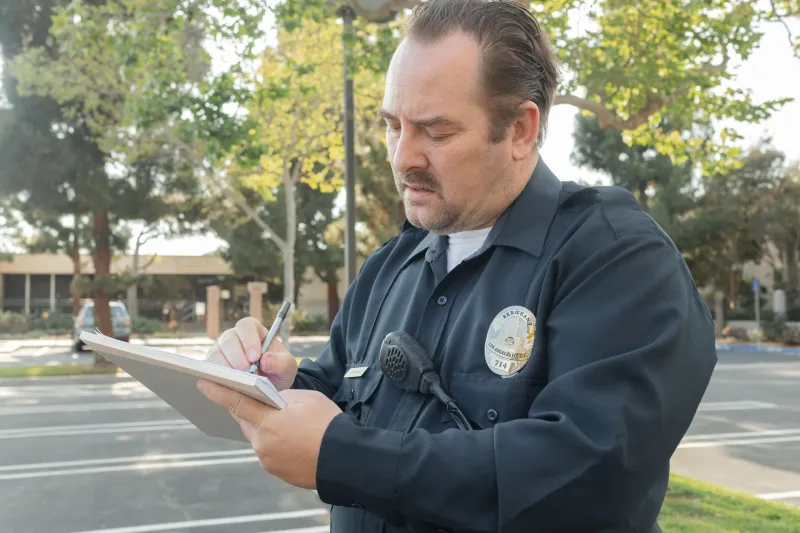
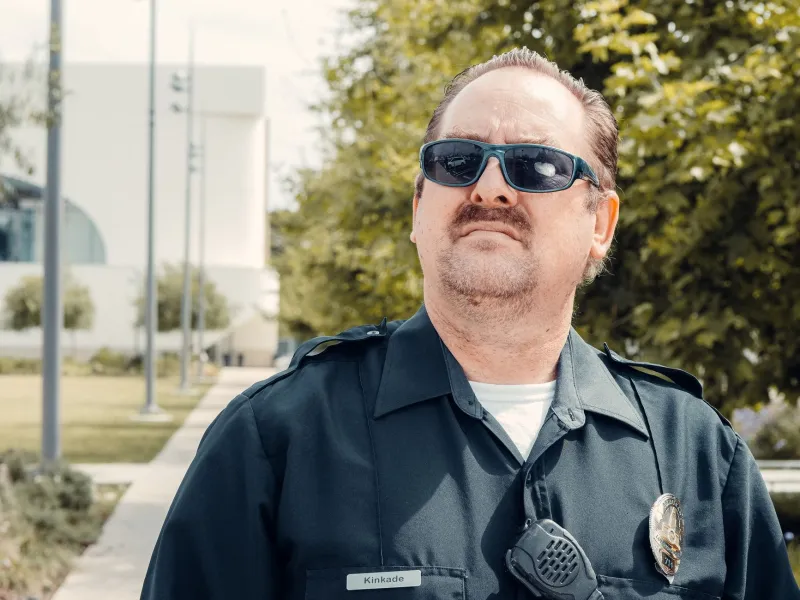
Guard presence calibrated to occupancy patterns. Stationary camera systems observe. Trained security personnel intervene. In parking environments where risk is elevated—high-volume retail lots, hospital parking structures, corporate campuses with late-shift operations—roving guard presence during peak ingress and egress periods provides a level of deterrence and response capability that technology alone cannot replicate. The visible presence of a uniformed professional fundamentally changes the behavioral calculus for anyone considering opportunistic criminal activity.
Emergency communication infrastructure. Call stations, intercom points, and clearly marked emergency contact information positioned throughout a parking area ensure that individuals in distress can summon assistance without having to navigate back to a building entrance. These systems also serve a psychological function: their presence signals that the space is monitored and that help is accessible.
Employee Safety as a Specific Priority
For businesses with employees who work early morning, late evening, or overnight shifts, the parking lot represents a direct occupational safety concern—not merely a property security issue.
An employee walking to their vehicle at 11:00 PM in a poorly lit, unmonitored lot is in a genuinely different risk environment than one leaving at 2:00 PM. Security planning should account for this distinction explicitly. Escort programs, where security personnel accompany employees to their vehicles upon request, address this vulnerability directly and carry the additional benefit of demonstrating organizational commitment to staff welfare—a factor that influences retention and morale in ways that extend well beyond the security department.
Assessing What You Actually Have
Most businesses have never conducted a formal assessment of their parking area security. The first step toward improvement is an honest evaluation of current conditions: where lighting is inadequate, where cameras have blind spots, where foot traffic is funneled through unmonitored areas, and where the physical environment creates concealment opportunities that would not exist with modest modification.
This assessment is most effectively conducted by a security professional who can evaluate the space through the lens of threat and opportunity rather than facility management alone. The findings frequently reveal that meaningful improvements are achievable at modest cost—and that the risk being carried in the absence of those improvements is substantially higher than the business had recognized.
Protecting the Whole Property, Not Just the Building
A security posture that ends at the front door is not a security posture—it is a partial defense with a predictable gap. The parking lot is where your employees begin and end their workdays, where your customers first interact with your property, and where threats that eventually reach your interior spaces often take their first form.
Treating it as an afterthought is a choice. So is treating it as the protected asset it actually is.
Alert Guarding Force works with businesses across the United States to evaluate, design, and staff comprehensive security programs that account for every element of the property perimeter—including the spaces that most security plans leave unaddressed. If your parking area has not received the same scrutiny as your building interior, the time to change that is now.