Distributed and Exposed: The Security Vulnerabilities Corporate America Created When It Sent Everyone Home

Photo: NASA/JPL-Caltech, CC, via Wikimedia Commons
A Perimeter That No Longer Exists
For most of the twentieth century, corporate security operated on a straightforward premise: define the boundary, control who crosses it, and monitor what happens inside. Guard stations, access badges, visitor logs, and closed-circuit cameras all served the same fundamental purpose — protecting a fixed, identifiable space.
Then, beginning in earnest in 2020 and accelerating through the years that followed, that premise collapsed. Employees took their laptops home. Conference rooms went dark. Office floors that once housed hundreds of workers sat empty or half-occupied. Businesses adapted quickly out of necessity, but their security frameworks did not keep pace. The perimeter dissolved, and with it, the visibility that physical protection had always depended upon.
What emerged in its place was not chaos — most companies continued to function. But beneath the surface of that operational continuity, a new and largely unexamined set of security vulnerabilities took root. Many of those vulnerabilities remain unaddressed today.
The Insider Threat Calculus Has Changed
Insider threats — whether malicious, negligent, or simply the result of poor judgment — have always been among the most difficult security challenges for any organization. When employees work in a shared physical environment, behavioral anomalies are at least theoretically observable. A guard making rounds notices the person still at their desk at midnight. A colleague sees someone photographing documents. A receptionist flags an unusual visitor.
In a remote environment, none of those natural checkpoints exist. An employee working from a home office in suburban Ohio or a co-working space in Austin operates almost entirely outside the visual and physical oversight structures that once provided passive deterrence. Access to sensitive files, proprietary systems, and confidential communications happens behind closed doors that no security professional can see through.
This is not a theoretical concern. According to reporting from cybersecurity and risk management organizations across the United States, insider-related incidents — including data exfiltration, unauthorized access, and negligent exposure of protected information — increased measurably during and after the widespread shift to remote work. The correlation is not coincidental. When physical oversight disappears, certain categories of risk expand to fill the void.
Access Control Without a Gatekeeper
One of the most underappreciated consequences of distributed work is what it has done to access control — not the digital variety, but the physical and procedural kind that security professionals have long relied upon.
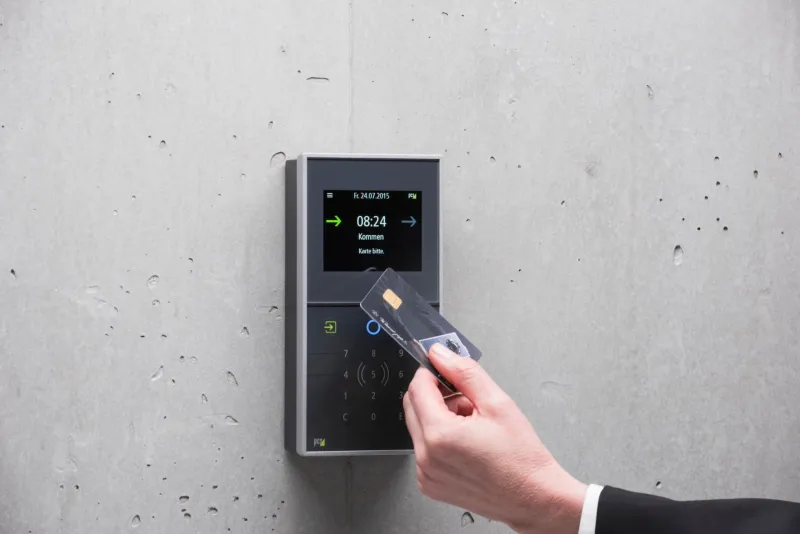
In a traditional office setting, access control is layered. A guard at the entrance verifies credentials. Badge readers restrict movement between floors or departments. Visitors are escorted. Sensitive areas require additional authentication. These layers work together to create a system where unauthorized access is difficult, detectable, and documented.
In a hybrid environment, many of those layers simply do not apply. Employees working remotely access company systems from personal networks, household devices, and occasionally public locations such as coffee shops, airports, and hotel lobbies. The physical security context surrounding that access is entirely unknown to the organization. There is no guard to verify that the person logging in is who they claim to be. There is no camera to document who else may be in the room. There is no controlled environment to fall back on.
When credentials are compromised — through phishing, social engineering, or simple password reuse — the absence of physical security layers means there is often nothing left standing between an attacker and sensitive organizational data.
Protecting Employees Who Are No Longer in the Building
The security obligation a business holds toward its employees does not terminate at the edge of the corporate campus. Workers conducting sensitive conversations, handling confidential materials, or representing the company in client-facing roles carry those responsibilities into whatever environment they happen to be working from — and those environments carry their own risks.
A financial services employee reviewing client portfolios at a shared co-working space faces shoulder-surfing exposure that would never exist in a properly secured office. A healthcare administrator discussing patient information over a video call in a public location may inadvertently violate privacy obligations. A corporate executive traveling between client sites may be far more physically vulnerable than their employer has accounted for.
These are not edge cases. They are routine realities of the modern distributed workforce, and they represent a category of risk that many businesses have yet to formally integrate into their security planning.
What Physical Security Can Still Accomplish
It would be a mistake to conclude from the above that physical security has become irrelevant in a remote-work world. The opposite is closer to the truth. Physical security has become more strategically important, even as its application has become more complex.
For the physical spaces that organizations still maintain — headquarters buildings, data centers, executive suites, warehouses, and satellite offices — the quality of on-site protection matters enormously. These locations often serve as the nodes through which distributed operations are coordinated and where the most sensitive physical assets remain concentrated. A lapse in access control at a central facility can have cascading consequences across an entire remote workforce.
Professional guard services continue to play a critical role in monitoring these environments, managing visitor protocols, responding to physical incidents, and maintaining the kind of active deterrence that no digital tool can replicate. The presence of trained security personnel at key locations sends a clear signal to would-be bad actors that the organization takes protection seriously — even if much of its workforce operates elsewhere.
Building a Security Framework for the Distributed Era
Addressing the blind spots created by remote and hybrid work requires a security strategy that is as decentralized as the workforce it protects. Several principles are worth building around:
Establish clear remote work security protocols. Employees should understand precisely what is and is not acceptable when working outside the office — from the networks they may use to the environments in which sensitive conversations can take place. These are not purely IT concerns; they are security policy matters that benefit from the same rigor applied to physical access control.
Conduct regular access audits. Credentials that are no longer needed should be revoked promptly. This is especially critical when employees depart the organization or change roles. The window between a status change and the removal of access is a known vulnerability that malicious actors have exploited in documented cases across multiple industries.
Maintain strong physical security at central locations. Even as the workforce disperses, the facilities that anchor an organization's operations require professional, consistent, and well-managed protection. Guard presence, access control systems, and surveillance infrastructure at these sites should be treated as non-negotiable.
Extend duty-of-care planning to remote employees. Risk assessments should account for the physical environments in which employees regularly work, particularly those who travel frequently or operate in higher-risk locations. Security briefings, personal safety protocols, and emergency response plans should be extended to the distributed workforce, not limited to those who report to a central office.
Integrate physical and procedural security planning. The most effective response to distributed-work vulnerabilities is a coordinated strategy that addresses both the digital and physical dimensions of risk simultaneously. Security planning that treats these as separate concerns will consistently leave gaps at the boundary between them.
The Organizations That Will Fall Behind
The businesses most at risk are not necessarily the smallest or the least sophisticated. They are the ones that made rapid, practical adaptations to remote work without revisiting their security assumptions — and then moved on, treating the transition as complete when in fact it had only begun.
The security landscape that existed before 2020 is not returning. The hybrid and remote workforce is a permanent feature of American corporate life, and the vulnerabilities it creates will not resolve themselves. Organizations that continue to operate under security frameworks designed for a centralized, office-bound workforce are, in effect, leaving significant portions of their operations unguarded.
At Alert Guarding Force, our approach begins with an honest assessment of where an organization's real vulnerabilities lie — not where they used to be. The shift to distributed work has been seismic. The security response to that shift should be equally deliberate.